
Table of Contents
- Why Most Eco-Friendly Candles Disappoint on Scent Throw
- Best Eco-Friendly Candles for Every Room and Mood
- Soy Candles With Strong Fragrance: How to Spot the Real Ones
- Non-Toxic Candles That Smell Good: Reading the Ingredient List
- Clean-Burning Scented Candles: Wick, Wax, and Vessel Checklist
- What Competitors Miss: Scent Testing, Disposal, and Layering
- Conclusion: Choosing a Candle That Performs and Lasts
- Frequently Asked Questions
Last Updated: October 7, 2026
Why Most Eco-Friendly Candles Disappoint on Scent Throw
If you've ever spent money on a beautiful eco-friendly candle only to smell nothing past arm's length, you're not imagining it. The problem is almost always fragrance load, not the wax itself. This guide from Mam Jam's explains what actually determines scent throw, how to read a label like an insider, and which eco-friendly candles earn their place in your home in 2026.
Here's the uncomfortable truth most candle brands avoid: "natural" and "strong" are not opposites, but they are rarely combined well. Many makers cut fragrance load to keep costs down, then lean on pretty packaging to sell the story. The ASTM candle fire safety standard exists precisely because wax, wick, and fragrance have to work together safely, and that balance is where scent throw lives or dies.
Eco-friendly candles are candles made with renewable, biodegradable waxes, phthalate-free fragrance, and lead-free wicks. The best ones combine that clean profile with a fragrance load high enough to fill a room. Below, we'll show you exactly how to spot the difference before you buy.
Hot Throw vs. Cold Throw: What the Label Doesn't Tell You
Cold throw is how strongly a candle smells before it's lit. Hot throw is how strongly it smells while burning. Cold throw is what sells a candle in a shop. Hot throw is what you actually live with.
Many brands optimize for cold throw because it's cheap to achieve with a strong top-note fragrance. Hot throw requires more fragrance oil, a properly sized wick, and a full melt pool. If a candle smells amazing unlit but fades within ten minutes of burning, you've found a cold-throw-only product.
Fragrance Load: The Number That Decides Everything
Fragrance load is the percentage of fragrance oil by weight in the wax. Most mass-market candles sit around 3-6%. Higher-performing candles typically run 6-10%, though the exact ceiling depends on the wax and wick combination.
The catch: more fragrance isn't automatically better. Push past what the wax can hold and you get soot, wick drowning, or a headache-inducing scent. This is where small-batch, hand-poured makers have an advantage. They can adjust load per scent instead of forcing every candle into one formula.
Best Eco-Friendly Candles for Every Room and Mood
The best eco-friendly candles match fragrance load to the room. A bedroom needs a lighter, softer throw. A large open-plan living space needs a higher load and often two candles burning together.
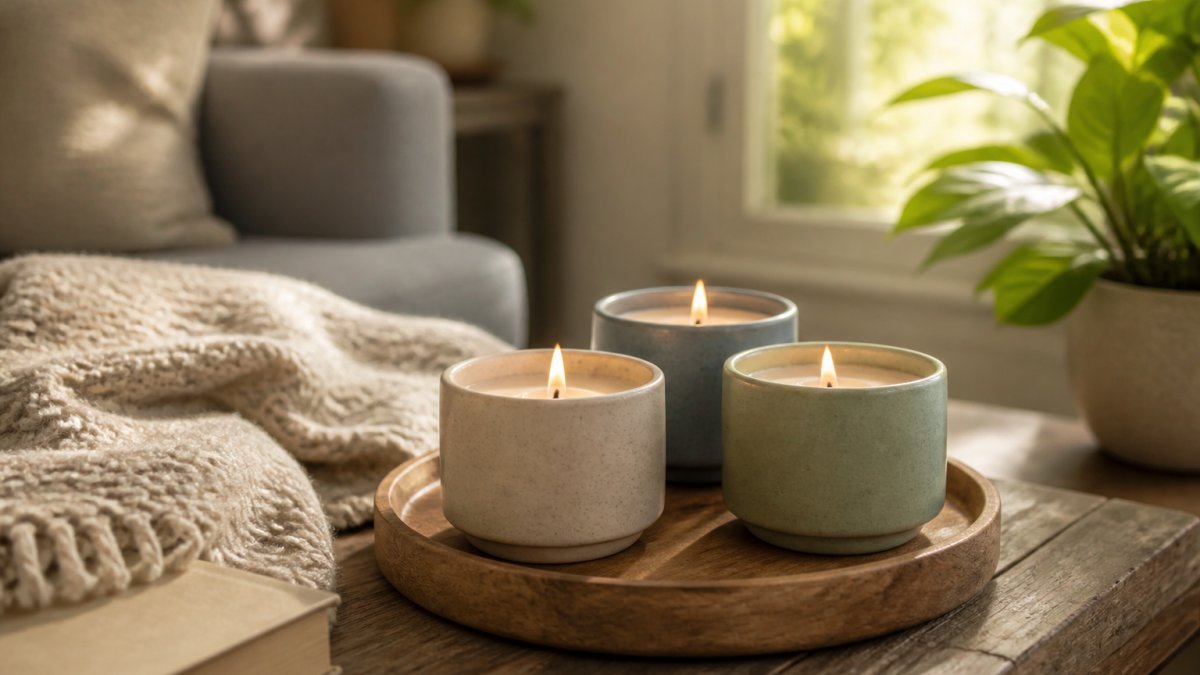
At Mam Jam's, every scent is hand-poured in small batches. That means a bakery-inspired candle can carry a heavier load without turning cloying, while a light floral stays gentle enough for a small apartment.
A simple room-by-room guide:
| Room | Throw Needed | Scent Style | Vessel Size |
|---|---|---|---|
| Bedroom | Light | Floral, lavender, soft bakery | 4-6 oz |
| Living room | Medium-high | Bakery, amber, seasonal | 8-10 oz |
| Bathroom | Medium | Citrus, herbal, clean | 4-6 oz |
| Open-plan kitchen | High | Warm spice, coffee, vanilla | 10 oz+ or two candles |
Soy Candles With Strong Fragrance: How to Spot the Real Ones
Soy candles with strong fragrance exist, but "soy" on a label is not a guarantee. Many blends are mostly paraffin with a splash of soy for marketing. Look for the words "100% soy wax" or "all-natural soy," not "soy blend." The real differentiator, however, is not the wax name, it's the fragrance load and how the maker formulates it.
Soy wax has a lower melting point and a softer crystal structure than paraffin, which means it holds less fragrance oil by weight before the oil starts to weep or the wick struggles to pull it into the flame.
Three quick checks before you buy:
- Fragrance load disclosure: Reputable makers list a percentage or at least say "high fragrance load." If the label only says "strong scent," treat it as marketing until proven otherwise.
- Wick size and type: A soy candle needs a larger wick than paraffin to reach a full melt pool. Undersized wicks cause tunneling and weak throw. Look for cotton or wood wicks sized specifically for the vessel diameter, not one-size-fits-all wicks.
- Burn instructions: A candle that says "trim to 1/4 inch and burn 2-4 hours" is telling you the maker understands wax behavior. Instructions that say "burn until fully melted" or omit burn time entirely are a red flag.
Non-Toxic Candles That Smell Good: Reading the Ingredient List
Non-toxic candles that smell good start with three things: phthalate-free fragrance, lead-free wicks, and paraffin-free wax. Skip any one and you've compromised the "clean" claim. But here's what most guides won't tell you: "non-toxic" and "strong throw" are not in conflict, they just require a different formulation strategy than the cheap candles most people are used to.
Phthalates are the plasticizers that make synthetic fragrance cling to a room longer. They're also the most common reason people get headaches from cheap candles.
Volatile organic compounds, or VOCs, are the other concern. All burning candles release some VOCs, but paraffin releases more than soy, coconut, or beeswax. The type of VOC matters too: paraffin tends to release more aromatic compounds like toluene and benzene, while plant waxes release primarily fatty acid derivatives. If indoor air quality matters to you, the wax choice is the first filter. The EPA indoor air quality guidance is a useful starting point for understanding what's actually in your home air.
Here's the gap most non-toxic candle guides miss: they tell you what to avoid but not how to evaluate whether a clean candle will actually perform. The answer is fragrance load and wick sizing, the same factors that determine throw in any candle.
When you're reading an ingredient list, look for these specifics:
- "Phthalate-free fragrance", this is the minimum. Better makers specify "phthalate-free, paraben-free" or list the fragrance house they source from.
- "Essential oil blend", essential oils can add natural scent but rarely provide strong throw on their own. A candle that is 100% essential oil will almost always have a weaker hot throw than one using a phthalate-free fragrance oil. The strongest clean candles typically use a hybrid: a base of phthalate-free fragrance oil with essential oils added for top-note complexity.
- "Lead-free cotton wick", lead wicks were banned in the U.S. in 2003, but imported candles may still contain them. Look for explicit "lead-free" labeling.
- "Paraffin-free", if the label says "soy blend" without specifying the paraffin percentage, assume it contains paraffin.
One more thing: don't confuse "non-toxic" with "unscented." A candle can be both clean-burning and strongly scented. The key is that the fragrance is phthalate-free and the wax is renewable. If a brand claims "non-toxic" but won't disclose its fragrance load or wick type, that's a sign they're optimizing for marketing, not performance.
Clean-Burning Scented Candles: Wick, Wax, and Vessel Checklist
Clean-burning scented candles need a lead-free wick, a renewable wax, and a vessel that doesn't off-gas when heated. Cotton and wood wicks are both fine, they just behave differently.
- Wick: cotton, wood, or paper, labeled lead-free
- Wax: 100% soy, coconut, or beeswax, not a paraffin blend
- Fragrance: phthalate-free, ideally with some essential oils
- Vessel: glass, ceramic, or tin, no plastic liners or painted interiors
- Burn time: listed on the label, usually 30-60 hours for an 8 oz candle
What Competitors Miss: Scent Testing, Disposal, and Layering
Most candle guides stop at "buy soy, avoid paraffin." That leaves three big gaps: how to test throw before committing, what to do with the jar when it's done, and how to layer scents without overwhelming a small space.
How to Test Scent Throw Before You Commit
Buy the smallest size first. Light it in the room where you plan to use it, let it burn for a full two hours, then leave the room for ten minutes and come back. Your nose adjusts to scent fast, so the "come back" test tells you what a guest actually smells.
If the scent is faint at the two-hour mark in a small room, it will be invisible in a larger one.
End-of-Life Disposal and Reusable Vessels
Soy wax is biodegradable and cleans up with warm soapy water, which makes disposal easy. Freeze the jar for an hour, pop the wax out, and either compost it or bin it. The vessel itself is the real sustainability win: glass and ceramic jars can be reused for tea lights, storage, or a refill pour.
Scent Layering and Olfactory Fatigue in Small Spaces
Olfactory fatigue is your nose tuning out a scent it's been exposed to continuously. In a small apartment, this happens within an hour. The fix is layering: burn a light base scent in one corner and a complementary top note in another, rather than one heavy candle in the middle.
Try a soft floral in the bedroom and a warm bakery scent in the kitchen. The two scents stay distinct, and neither one overwhelms the space.
Conclusion: Choosing a Candle That Performs and Lasts
The real challenge with eco-friendly candles isn't finding one that's clean-burning, it's finding one that's clean-burning and strong enough to actually change a room. That balance comes down to fragrance load, wick sizing, and a maker who tests each scent instead of trusting a formula.
At Mam Jam's, we hand-pour every all-natural soy candle in small batches, using phthalate-free fragrance and clean-burning wicks so the scent carries without the headache. Our collections run from floral to bakery-inspired, designed to suit any room and any mood.
Get started with Mam Jam's and turn your space into a cozy haven that actually smells like it.
Frequently Asked Questions
Do soy candles have a strong scent throw?
Soy candles can have a strong scent throw. The misconception that soy is always faint comes from low-quality soy blends with minimal fragrance oil.
How can you tell if a candle will fill a room with fragrance?
Look for three signals on the label or product page: the fragrance load percentage, the wax type (soy, coconut, or beeswax blends hold scent well), and the wick material (cotton or wood, never lead-cored). Cold throw, the scent you notice before lighting, is a useful preview but not a guarantee. A candle with strong cold throw and a high fragrance load will usually deliver a strong hot throw once the melt pool reaches the edges.
Are scented candles with essential oils stronger than candles with fragrance oils?
Not necessarily. Essential oils are natural but often have a lighter, less concentrated scent than synthetic fragrance oils. If you want a powerful scent and clean indoor air quality, choose a candle labeled phthalate-free and paraffin-free, and check whether the brand discloses its fragrance load. Essential-oil-only candles tend to be subtler and work best in small rooms.
How do I know the 'all-natural soy' claim is legit and not just marketing?
Look for transparent ingredient lists that name the wax, wick, and fragrance components. A legitimate soy candle brand will state whether the wax is 100 percent soy or a soy blend, and will confirm the candle is phthalate-free and paraffin-free. If a brand cannot answer these questions or points only to pretty packaging, treat the claim with caution.
This article was written by the Mam Jam's team. For current pricing, availability, and scent collections, visit our shop.