

Table of Contents
- Why Aesthetic Candles Change a Room
- Trending Candle Styles Shaping 2026 Interiors
- Candle Styling Ideas for Every Room
- Candles for Small Spaces: Styling Without the Clutter
- Why Soy Candles for Home Decor Are Worth the Switch
- Choosing Scents, Colors, and Vessels That Match Your Space
- Candle Safety and Burn Care: What Most Guides Skip
- Conclusion
- Frequently Asked Questions
Last Updated: October 6, 2026
Why Aesthetic Candles Change a Room
Aesthetic candles for home decor are scented or decorative candles chosen to complement a room's visual style, scent profile, and mood. At Mam Jam's, we hand-pour all-natural soy candles for exactly this reason: a candle is decor, fragrance, and lighting in one object.
A single well-chosen candle adds warm light, a scent layer, and a sculptural accent without a renovation or a plug socket. Designers lean on this trick because it is the cheapest way to make a room feel finished.
Below, we'll show you how to choose shapes, scents, and vessels for each room, plus the burn-care steps most guides skip.
Trending Candle Styles Shaping 2026 Interiors
Trending candle styles in 2026 fall into two camps: bold sculptural shapes that act as art objects, and quiet minimalist palettes that let texture do the talking. Knowing your camp makes every later decision easier.
Sculptural and Shaped Candles
Sculptural candles are decorative candles cast in unusual forms: spirals, arches, knots, spheres, busts, and abstract pillars. They're meant to be seen, not just burned.
A common mistake is treating them as everyday candles. Sculptural candles burn unevenly by design, because the form matters more than the fuel. Display them, burn them occasionally, and keep a separate pillar or votive for regular use.
For a shelf or mantel, one sculptural piece beats five small ones. Let it stand alone with a book and a small vase.
Minimalist and Modern Palettes
Minimalist and modern candle styling is about restraint: neutral tones, clean silhouettes, and one point of interest per surface. Cream, sand, stone, charcoal, and soft clay fit almost any interior.
Texture carries the look when color doesn't. Ribbed pillars, matte finishes, and smooth ceramic vessels give a monochrome arrangement something to catch the light.
Modern also means practical. A taper in a slim holder, a votive in a stoneware cup, a single pillar on a tray: three objects, one mood, zero fuss.
Candle Styling Ideas for Every Room
Candle styling ideas work best when they start from how a room is actually used, not from a photo. Light, foot traffic, and surface space decide the arrangement before taste does.
Below is a quick reference we use when planning a display.
| Room | Best Candle Types | Placement | Scent Direction |
|---|---|---|---|
| Living room | Pillars, tapers, sculptural | Coffee table tray, mantel | Warm bakery or woody |
| Entryway | Votives, tealights | Console, key dish | Fresh floral |
| Bedroom | Votives, small pillars | Nightstand, dresser | Soft floral or herbal |
| Bathroom | Tealights, votives | Tub ledge, shelf | Clean, light floral |
| Small spaces | Tealights, one sculptural | One shelf, one corner | Single light scent |
Living Room and Entryway Displays
The living room and entryway are display rooms, so this is where aesthetic candles earn their keep. Group candles by height rather than scattering them: a tall taper, a mid pillar, and a low votive on one tray reads as intentional.
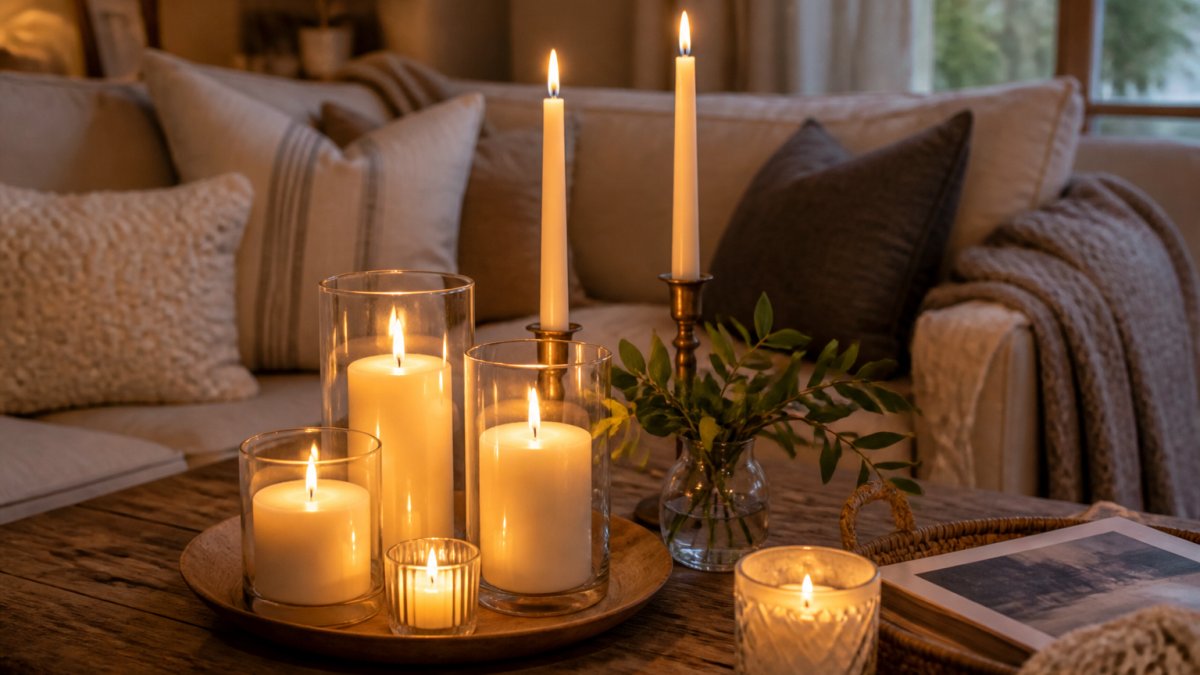
For an entryway, keep it low and safe. A votive or tealight on a console beside a key dish and a small plant sets the tone without blocking the walkway. Never leave a lit candle where coats or bags brush past it.
Bedroom and Bathroom Ambiance
Bedrooms and bathrooms want ambiance, not a statement. Two or three votives on a nightstand, or a single pillar beside a bath, do more than a full shelf.
Scent matters more here than shape. Choose something soft and familiar for winding down, and keep the strongest scent out of small, steamy rooms where it will feel heavy.
Candles for Small Spaces: Styling Without the Clutter
Candles for small spaces follow one rule: one surface, one grouping, one scent. In a studio or small apartment, a candle display competes with everything else you own, so restraint is the whole strategy.
Start with height. A single tall taper or slim pillar draws the eye upward and makes a low ceiling feel less pressing. A useful ratio: keep the candle plus holder at roughly one-third the height of the surface it sits on.
Then limit the scent. One candle burning in a small space carries further than three, and layering scents in a tight room quickly turns overwhelming.
Placement matters more than quantity in tight rooms. Three placements that consistently work:
- Vertical corner stack: one tall pillar on a slim pedestal in a corner, with a small plant or stack of two books at its base. The vertical line stretches the room.
- Tray grouping on a coffee table: one mid-height pillar, one votive, and one non-candle object (a small bowl, a single stem in a bud vase). Odd numbers read as styled; even numbers read as a set.
- Floating shelf vignette: a single sculptural candle with one book laid flat and one upright. This is the highest-impact option for renters who can't add furniture.
Finally, use the candle as the accent, not the collection. A tray with one candle, one small plant, and one object you love will always look better in a small room than a row of ten.
One safety note specific to small rooms: candles in tight spaces sit closer to curtains, bedding, and paper than they would in a large room. Keep at least 30 cm of clear space above and around any lit flame, and never place a candle on a shelf directly beneath another shelf.
Why Soy Candles for Home Decor Are Worth the Switch
Soy candles for home decor are worth the switch because soy wax burns cooler and slower than paraffin, and it holds color and shape well enough for decorative use.
Wax types, honestly compared.
- Paraffin: petroleum-derived, throws scent aggressively and instantly, holds bright dye colors well. Burns hotter and faster, and can soot if the wick isn't trimmed. The trade-off is performance versus origin.
- Soy: plant-derived, burns cooler and slower, cleans up with warm soapy water, and takes color and shape well. Scent throw is gentler and needs a proper cure and a full melt pool before it fills a room.
- Beeswax: naturally firm, subtle honey note, very long burn, but expensive and harder to cast into complex shapes. Best for pillars and tapers rather than sculptural pieces.
- Coconut and blends: often used to boost soy's throw and smooth the surface finish. Many artisan makers blend soy and coconut for exactly this reason.
The honest caveat on soy: give it twenty to thirty minutes and it performs. Expect instant, room-filling scent from the first minute and you'll be disappointed by any natural wax.
Fragrance ingredients. Look for "phthalate-free" on the label.
Vessel reusability. This is where decor candles earn their keep. A candle in a reusable vessel is two products: the candle, then the jar, tin, or ceramic cup.
Packaging and shipping weight. A candle's carbon footprint is dominated by shipping weight and vessel material, not the wax itself.
What to actually check on a label.
- Wax type (soy, coconut, beeswax, paraffin, or a named blend)
- Fragrance disclosure (phthalate-free is the common marker)
- Wick type (cotton, paper, or wood, wood wicks crackle and need extra trimming)
- Net weight in grams, which predicts burn time more reliably than jar size
- Whether the vessel is described as reusable
Choosing Scents, Colors, and Vessels That Match Your Space
Matching scents, colors, and vessels to a room comes down to three decisions: how strong, how warm, and how visible.
On scent, think in families rather than names:
- Floral: soft, familiar, good for bedrooms and bathrooms
- Bakery and gourmand: warm and inviting, best in kitchens and living rooms
- Woody and herbal: grounding, suits studies and entryways
- Fresh and clean: light, works anywhere but disappears in large rooms
On color, pull one tone from the room and repeat it. A cream candle on a cream sofa looks deliberate; a bright candle on a neutral shelf looks like an accident.
On vessels, match the material to the room's finishes. Patterned and colored glass catch light and suit maximalist or vintage rooms; matte ceramic suits modern and minimalist spaces; clear glass is the safe default because it shows the wax and flame.
For gifting, a handcrafted candle in a reusable vessel covers birthdays, anniversaries, and housewarmings in one purchase. Choose a scent family the recipient already wears or cooks with, and you'll rarely miss.
Candle Safety and Burn Care: What Most Guides Skip
Candle safety and burn care decide whether a candle looks good for a month or a week. Most guides skip the two rules that actually ruin candles: trimming and the first burn.
Trim the wick to about 5 millimetres before every burn. Long, curled wicks smoke, soot the vessel, and burn fuel faster than the flame needs.
The first burn sets the candle's memory. Let the wax melt all the way to the edge of the vessel before you blow it out, or you'll get tunneling: a candle that burns straight down the middle and leaves a ring of wasted wax. This is the most common candle complaint, and it's almost always a first-burn problem rather than a manufacturing fault.
A few more that matter:
- Never burn longer than four hours at a stretch
- Keep candles away from curtains, drafts, and anything flammable
- Place them on a heat-safe tray, never directly on wood or fabric
- Extinguish with a snuffer or the lid rather than blowing, which scatters soot
- Stop burning when 1 centimetre of wax remains, and reuse the vessel
For guidance on household fire safety and open flames, check your local fire service's published advice before setting up a new display.
Conclusion
The hardest part of styling with candles isn't finding something pretty, it's finding one that looks right, smells right, and burns cleanly without tunneling or overwhelming a small room.
Our all-natural soy candles are hand-poured in small batches, clean-burning, and finished with phthalate-free fragrance, so they work as decor and as daily ritual.
Get started with Mam Jam's and turn one shelf, one corner, or one evening into something that feels like a haven.
Frequently Asked Questions
What types of candles work best as home decor?
Pillar, taper, votive, and tealight candles all work well, but the vessel and shape matter most. Patterned glass jars and sculptural designs double as decorative accessories even when unlit. For home decor, look for soy or other natural waxes that burn cleanly, and choose colors and finishes that match your existing palette. Rotating seasonal scents and shapes keeps the display feeling fresh without buying new furniture.
How do you style candles in a small living room?
Group two or three candles of different heights on a single tray or shelf rather than scattering them around. Stick to one or two vessels in matching or complementary finishes so the eye has a focal point. Mirror or glass surfaces bounce candlelight and make a small room feel larger. Choose lighter scents for small spaces so fragrance does not become overwhelming in a closed room.
Are soy candles a good choice for home decor?
Soy candles for home decor are popular because they burn cleanly, produce less soot than paraffin, and hold scent well in a room. They also take color and vessel styling easily, which matters if the candle is part of your display. Look for all-natural, phthalate-free soy wax if you are sensitive to strong fragrances, and check the burn time on the label before buying.
What is the 84 rule for candles?
The 84 rule is a simple memory aid for candle care: trim the wick to about 4 to 8 millimetres before every burn, and keep the first burn going long enough so the melt pool reaches the edge of the vessel. Following it prevents tunneling, where the middle burns down while wax stays stuck to the sides, and it helps the candle last through its full stated burn time.